Blog / AI Search & AEO / Guides
October 22, 2026
What Is AEO? Answer Engine Optimization for Shopify Stores
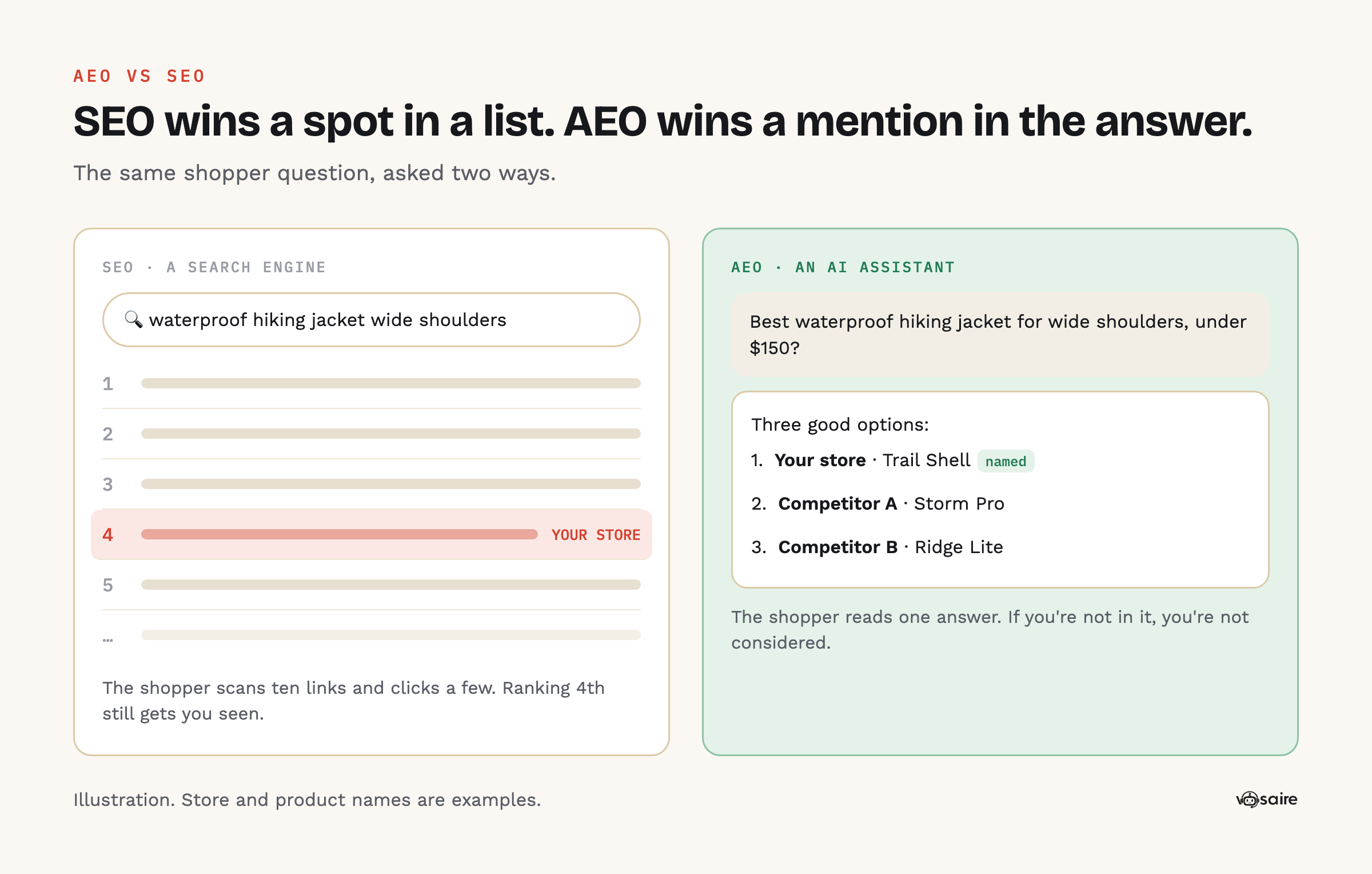
AEO (answer engine optimization) is the work of making your store easy for AI assistants like ChatGPT, Gemini and Perplexity to find, understand and recommend when a shopper asks them what to buy. It builds on SEO rather than replacing it: the assistants still read web pages and search indexes, but instead of showing ten blue links they write one answer that names a handful of stores. AEO is about being one of those names.
If you run a Shopify store, AEO has stopped being a theory. Adobe Analytics measured that during the 2025 holiday season, traffic to US retail sites from generative AI tools rose 693.4% year over year, while noting that "the base of users remains modest" (Adobe). And Shopify now sends products from eligible stores into ChatGPT, Google AI Mode, Gemini, Microsoft Copilot and Meta through agentic storefronts. Shoppers are asking, and assistants are answering with products.
This guide explains what AEO is, how it differs from SEO and GEO, how AI assistants actually pick products, and which parts are in your control.
AEO vs SEO vs GEO: what's the difference?
The three terms overlap a lot. The easiest way to keep them apart is to ask where the shopper sees the result.
| SEO | AEO | GEO | |
|---|---|---|---|
| Stands for | Search engine optimization | Answer engine optimization | Generative engine optimization |
| Where the result shows | A list of links on Google or Bing | A written answer from ChatGPT, Gemini, Perplexity, Copilot | Same as AEO |
| What "winning" looks like | Ranking high on the results page | Being named or cited in the answer | Being named or cited in the answer |
| What you measure | Rankings, clicks, impressions | How often you're mentioned, your position, which sources are cited | Same as AEO |
GEO and AEO are, for practical purposes, two names for the same thing. "GEO" comes from academic and agency circles; "AEO" is more common among SEO teams. Some people use AEO for short factual answers (featured snippets, voice assistants) and GEO for long AI-written answers, but for a Shopify merchant the work is the same.
SEO is still the foundation. Google says plainly that there are "no additional requirements to appear in AI Overviews or AI Mode, nor other special optimizations necessary" and that a page only needs to be indexed and eligible to show a snippet (Google Search Central). ChatGPT's search features rely on OpenAI's own crawler, OAI-SearchBot, and OpenAI says sites that block it "will not be shown in ChatGPT search answers" (OpenAI). If search engines and AI crawlers can't read your store, no amount of AEO will help.
What AEO adds on top is a different question. SEO asks, "Does my page rank for this keyword?" AEO asks, "When a shopper describes what they want, does the assistant think of my store, and does it have enough trustworthy information to recommend it?"
How do AI assistants decide which products to recommend?
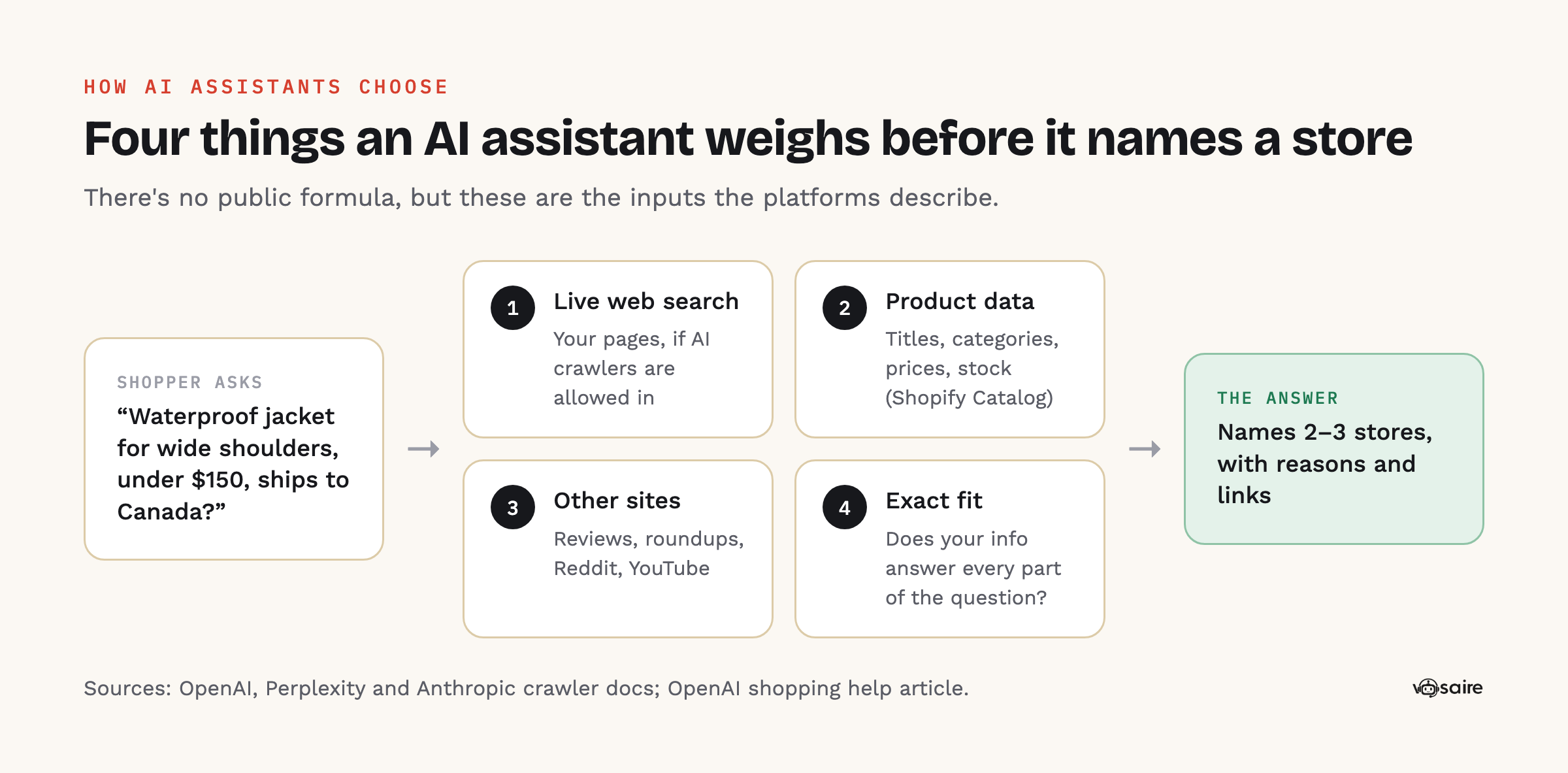
There's no public ranking formula, and anyone who claims to know the exact weights is guessing. But the assistants and platforms have said a fair amount about the inputs.
1. They search the web live
When ChatGPT, Perplexity, Gemini or Copilot answer a shopping question, they usually run a web search first and write the answer from what they find. That's why crawler access matters so much: OpenAI's OAI-SearchBot, Perplexity's PerplexityBot and Anthropic's Claude-SearchBot all decide whether your pages can appear in their search results (OpenAI, Perplexity, Anthropic).
2. They read structured product data
For product carousels, ChatGPT pulls from product feeds and merchant metadata. OpenAI's shopping help article says product results "are selected independently by ChatGPT and are not ads," that ChatGPT may weigh things like price and reviews, and that merchants are ranked "based on factors like availability, price, quality, and whether they are the maker or primary seller of that item." It also says Shopify merchants are included through Shopify Catalog (OpenAI Help Center).
On Shopify, that means your product titles, descriptions, categories, variants, prices, stock and policies are being read by machines, not just shoppers.
3. They trust what other sites say about you
AI answers cite sources: review sites, "best of" roundups, Reddit threads, YouTube reviews, comparison articles, and brand sites. If three independent sources say your hoodie is the warmest under $100, an assistant has much more reason to name you than if only your own product page says so.
4. They match the shopper's exact situation
Shoppers ask assistants much longer, more specific questions than they type into Google: "a waterproof hiking jacket for wide shoulders under $150 that ships to Canada." The assistant looks for stores whose information answers every part of that question. A product page that says "great jacket, very comfy" gives it nothing to work with. A page that lists the waterproof rating, fit notes, price and shipping countries does.
Why AEO matters for Shopify stores specifically
Three things make AEO more pressing for Shopify merchants than for most websites:
- Shopify is already plugging your catalog into AI channels. Agentic storefronts are "active by default for eligible stores," and you can manage which AI channels your products appear on under Sales channels → Agentic in your admin (Shopify Help Center). Whatever is in your catalog is what those channels see.
- Shopping questions are recommendation questions. "What's the best…", "which brand…", "is X worth it?" are exactly the questions where an assistant names two or three stores and ignores the rest.
- Small stores can win. AI answers aren't limited to the biggest brands. A store with clear, specific product information and a few good third-party mentions can be named next to much larger competitors for a precise question.
What can a store owner actually control?
You can't control what an AI assistant says. You can control almost everything it reads about you. Here's how the work breaks down.
Access: can AI reach your store?
- Your store isn't behind a password page.
robots.txtallows the search crawlers: OAI-SearchBot, PerplexityBot, Claude-SearchBot, and Googlebot. (Training crawlers like GPTBot are a separate decision; blocking them doesn't remove you from search answers.)- Your refund, shipping, privacy and terms policies are published, since assistants answer policy questions too.
Shopify's default robots.txt is already sensible; the risk usually comes from old theme edits or third-party firewalls. We cover how to check this in how to get your Shopify store recommended by ChatGPT.
Product data: can AI understand what you sell?
Shopify's own guide to optimizing a store for AI recommends clear titles, detailed specifications, comparison information, sizing guides, material and care details, and structured product attributes (Shopify Help Center). In practice:
- Set a product category from Shopify's Standard Product Taxonomy on every product, and fill in the category metafields (material, size, color, and so on) that come with it (Shopify Help Center).
- Write titles that say what the product is: "Women's Waterproof Hiking Jacket – Navy," not "The Ridge."
- Answer the obvious buyer questions on the page: who it's for, sizing, materials, what's included, shipping and returns.
Answers: does your store answer the questions shoppers ask?
Find the questions shoppers ask about your category, then make sure a page on your store answers each one directly: buying guides, comparison pages, FAQ sections. Shopify also offers a free first-party Knowledge Base app where you can see and customize the FAQs AI shopping agents use about your store (Shopify Help Center).
Reputation: do other sites vouch for you?
Reviews on your products, mentions in roundup articles, honest discussion on Reddit or in niche communities, and creator videos all give assistants independent evidence. This is the slowest part of AEO, and usually the one that moves results most for competitive questions.
Measurement: do you know where you stand?
You can't improve what you don't check. At minimum, ask the main assistants your top buyer questions every few weeks and note who gets named. For a first baseline in a minute, run the free check of whether ChatGPT recommends your store. Also track the visits and sales that AI assistants send you. We wrote a separate guide on tracking ChatGPT traffic and sales in Shopify.
What about llms.txt and agents.md?
llms.txt is a proposal from 2024 for a Markdown file that gives language models a short, curated overview of a site. Plenty of Shopify apps generate one. It doesn't hurt, but don't expect it to move results on its own: Google says you "don't need to create new machine readable files, AI text files, or markup to appear in these features" (Google Search Central), and none of the major assistants has said it ranks stores by their llms.txt.
Treat these files as a small, cheap extra. Your product data, your answer pages and your reputation matter far more.
A simple AEO checklist for Shopify
| Area | Check | How often |
|---|---|---|
| Access | No password page; search crawlers allowed in robots.txt; policies published | Once, then after theme changes |
| Product data | Category and category metafields set; clear titles; specs, sizing and materials on the page | Every new product |
| Answers | One page that directly answers each top buyer question | Monthly |
| Reputation | Asking for reviews; pitching roundups; helpful answers in communities | Ongoing |
| Measurement | Ask the assistants your buyer questions; track AI visits and orders | Every 1–4 weeks |
How long does AEO take to work?
It depends on what's holding you back. Fixing crawler access can show up within days: OpenAI says robots.txt changes take about 24 hours to apply to search results (OpenAI). Better product data and new answer pages usually take weeks to be crawled and picked up. Winning competitive questions where a well-known brand dominates the sources can take months. And because AI answers vary from one run to the next, judge progress by the trend over several checks, not a single answer.
FAQ
Is AEO replacing SEO?
No. AI assistants rely on crawling and search indexes, so the basics of SEO (crawlable pages, clear content, good site structure) are the foundation of AEO. AEO adds a focus on answering specific buyer questions and earning mentions on other sites.
Is GEO the same as AEO?
For Shopify merchants, yes. Both describe getting your brand named and cited in AI-written answers. The terms come from different communities but describe the same work.
Can anyone guarantee that ChatGPT will recommend my store?
No. Nobody controls what an AI assistant says, and answers change between runs. Be wary of any service that promises a guaranteed position. What you can do is remove the reasons an assistant can't or won't name you.
Do I need an app to do AEO?
No. Everything in this guide can be done by hand. An app saves time on the repetitive parts: asking the assistants your questions on a schedule, spotting which competitors win and why, and drafting fixes. That's what we built Vosaire AI Visibility for (see how it works), and our comparison of AI visibility apps for Shopify covers the other options too.
Where should I start?
Check access first (it's quick and can block everything else), then fix product data on your best-sellers, then write answer pages for the questions where competitors are named instead of you. Our step-by-step guide on how to get your Shopify store recommended by ChatGPT walks through each one.