Blog / AI Search & AEO / Comparisons
October 22, 2026
The Best AI Visibility (AEO) Apps for Shopify in 2026, Tested
The best AI visibility app for your Shopify store depends on what you need: some apps only publish technical files like llms.txt, some fix your product data, and a few actually ask ChatGPT and other assistants your buyers' questions and show who gets recommended. If you want to know whether AI recommends your store, pick an app that tracks real answers. If you mainly want cleaner product data, a catalog-fixing app is cheaper.
Full disclosure: we make one of these apps, Vosaire AI Visibility, and it isn't on the Shopify App Store yet. We've tried to write the comparison we'd want to read ourselves: each app installed on the same test store, every free page opened, prices checked on each app's live Shopify App Store listing on 22 October 2026. Where a competitor does something better than us, we say so.
How we tested
We installed each app on a Shopify development store with 15 demo products (snowboards) on 19–20 October 2026, on each app's free plan. We opened every page, ran every free action, and noted what we could see without paying. We didn't approve paid charges, so paid-only features are described from each app's listing and labeled that way.
Two things to keep in mind:
- A dev store with 15 products is not your store. Some apps behave differently with large catalogs or real traffic.
- These apps change fast. Most launched in the last year. Check the listing before you install.
What kinds of AI visibility apps are there?
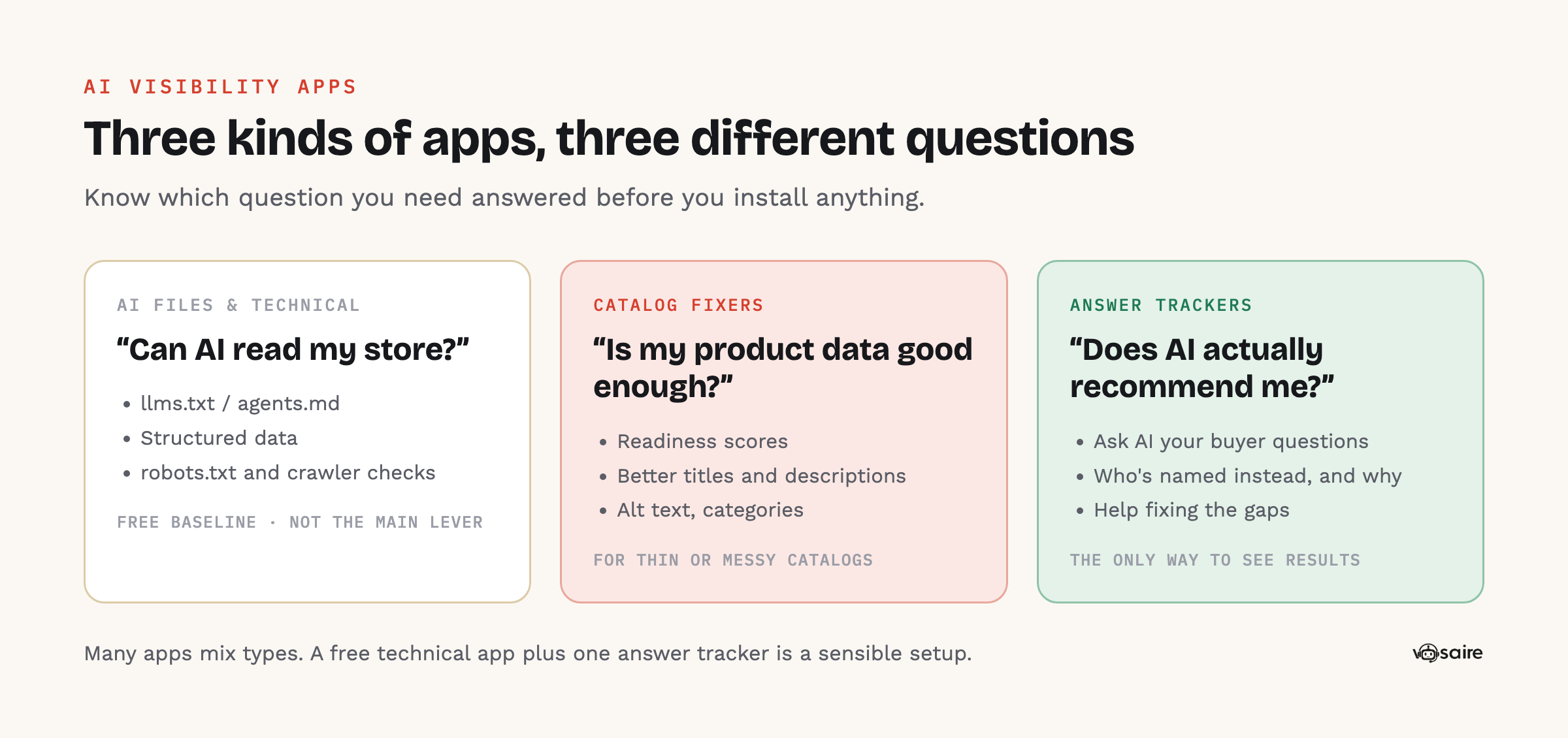
Almost every app in this category falls into one of three groups. Knowing which one you need saves a lot of time.
| Type | What it does | Good for |
|---|---|---|
| AI files & technical | Publishes llms.txt / agents.md, structured data, IndexNow pings, robots.txt checks | A quick, free technical baseline |
| Catalog fixers | Scores your product data and rewrites titles, descriptions, alt text | Stores with thin or messy product data |
| Answer trackers | Ask AI assistants your buyer questions, show who's named and why, then help you fix it | Knowing whether AI actually recommends you |
The technical group is useful but limited. Google says you "don't need to create new machine readable files, AI text files, or markup" to appear in its AI features (Google Search Central). The files don't hurt; they just aren't the main lever. We explain why in what AEO is.
The apps at a glance
Prices and ratings from each app's Shopify App Store listing on 22 October 2026.
| App | Type | Free plan | Paid plans | Rating |
|---|---|---|---|---|
| Kedra: AI SEO & AEO Visibility | Answer tracker + files + fixes | Yes | $10, $25, $79/mo | 4.9 (48) |
| Yumnaz AI SEO: AEO & ChatGPT | Answer tracker + fixes | Yes | $49, $149/mo | 5.0 (4) |
| ShopRank AI: Rank in ChatGPT | Catalog fixer | Yes (50 products) | From $9.99/mo | 4.7 (42) |
| Entitled AI Visibility AEO GEO | Catalog fixer + mention check | Yes | $4.99/mo | 5.0 (3) |
| GPTLab: ChatGPT Claude AEO SEO | AI files & technical | Free | None listed | 4.9 (345) |
| Avada AEO SEO Optimizer LLMs | AI files & technical | Free | None listed | 5.0 (390) |
| Vosaire AI Visibility (ours, coming soon) | Answer tracker + fixes + answer pages | Yes | $19, $49, $99/mo | New, no reviews yet |
Kedra: the strongest all-rounder for the price
Kedra is the closest to a complete AEO tool at a low price, and the app we'd call our most direct competitor.
What it does: checks visibility on several AI engines, tracks whether ChatGPT and Gemini name you for buyer questions, publishes llms.txt and agents.md, suggests fixes you approve, writes blog posts for questions where AI skips you, and tracks AI traffic and sales. Paid plans add daily tracking, markets and more questions.
What we liked: its "opportunities" view is genuinely smart. It groups questions where getting onto one more cited site would put you in the answer, which is a very practical way to prioritise. The setup wizard shows your agents.md being built as you go. And $10/month for weekly checks is a low entry price.
What to watch: the number of tracked buyer questions is small on the cheaper plans (12 on Grow, 30 on Pro, per the listing). On our test store, the first questions it wrote were based on the store's name rather than its products, so check and edit the questions it suggests before trusting the results.
Best for: small stores that want tracking, fixes and AI files in one app on a tight budget.
Yumnaz AI SEO: the clearest "what to fix next"
Yumnaz focuses on buying questions and product fixes, and it's the best of the group at telling you what to do next.
What it does: checks buying questions, rewrites thin product titles, descriptions and tags using only your recorded product data, publishes llms.txt and agents.md, tracks AI visits, and drafts buying guides for questions you lose (on paid plans).
What we liked: a weighted score that shows which part of your store drags the number down, and a "one fix at a time" flow (Apply, Done/next, Not relevant to my store) that's far less overwhelming than a long list. Its copy is refreshingly honest about how long AI visibility takes.
What to watch: on the free plan we could see that AI named someone else, but not read the answers. The first paid plan is $49/month.
Best for: owners who want a guided, step-by-step fixing experience and are ready to pay for tracking.
ShopRank AI: best for product data on a budget
ShopRank, by Zipify, is a catalog tool rather than an answer tracker, and it's very good at that job.
What it does: scores products against 17+ factors that can keep them out of AI search, fixes titles, descriptions and images with AI (including image upscaling and alt text), adds JSON-LD structured data, tracks searches in Shopify's catalog and an AI-attributed revenue dashboard.
What we liked: fixing fields inline, product by product, feels natural in the Shopify admin, and the store-vs-competitor score comparison with a target line gives you a clear goal.
What to watch: it doesn't show you what ChatGPT or Gemini actually say about your store. The free plan covers 50 products. We also saw ads for the developer's other apps inside it.
Best for: stores whose main problem is thin product data, especially larger catalogs where per-product fixes add up.
Entitled: cheapest paid plan, focused on titles and meta
Entitled grades and rewrites titles and meta descriptions, and checks how often ChatGPT and Claude mention your store.
What we liked: changes are written to Shopify's own fields, so they stay if you uninstall, and you can undo them. At $4.99/month it's the cheapest paid plan here. In our test it also drafted good, honest FAQs ("the store doesn't specify…") for Shopify's Knowledge Base app.
What to watch: its buyer questions were templates, and editing them is a Pro feature. It's narrower than the trackers above.
Best for: stores that want quick, reversible title and meta improvements for very little money.
GPTLab: the best free technical toolkit
GPTLab is the most-reviewed app in the group and is free. It's a technical toolkit, not a tracker.
What it does: llms.txt, JSON-LD structured data, IndexNow submissions, robots.txt checks, and AI traffic insights through GA4.
What we liked: a clean step-by-step setup with a progress bar, and a crawler check that shows which AI bots your robots.txt allows, grouped by provider.
What to watch: it doesn't ask AI assistants your questions, so it can't tell you whether you're recommended. Its "LLM outreach" looked to us like a log of checks rather than anything sent to ChatGPT, so don't read it as a submission to the assistants.
Best for: a free, solid technical baseline, possibly alongside a tracker.
Avada AEO: free llms.txt with good controls
Avada's app is free and highly rated, and does one thing well: it generates and hosts an llms.txt file, lets you choose which bots and which products, collections or blog posts it covers, and keeps it updated on a schedule. It also adds an AEO checklist score and AI referral traffic.
What to watch: like GPTLab, it doesn't show you what assistants say about you. On our test store the checklist panel showed zeros while the summary said "7 issues," a small bug but confusing. The app also promoted the developer's other apps.
Best for: anyone who wants llms.txt handled for free with fine-grained control.
Vosaire AI Visibility (ours): where it fits
We built Vosaire AI Visibility as an answer tracker that also fixes things. It isn't on the Shopify App Store yet, so you can't install it today, and it has no reviews (you can try its free ChatGPT check on any store). Here is what it does, so you can judge it against the others when it launches:
- Questions from your catalog: it writes the buyer questions from your actual products and collections, and you can edit them.
- Real answers you can read: it asks ChatGPT on every plan, adds Gemini and Perplexity on Growth and Claude and Grok on Pro, with web search on, and stores each full answer, who was named, and in which position.
- Why competitors win: on Growth, it compares a winning competitor's answer with your store and lists what to change.
- Fill AI gaps: for questions where you're not mentioned, it drafts a page or blog post from your real product data for you to approve.
- Accuracy alerts and an agent test (Growth and Pro): it flags when AI gets your prices or policies wrong, and tests whether an AI shopping agent can find a product and reach checkout.
- AI sales: storefront tracking counts orders from shoppers who visited from an AI assistant in the 30 days before buying.
Plans are Free, $19, $49 and $99/month (pricing, docs). Where others are ahead: Kedra is cheaper to start with and already has markets and citations-based opportunities in production; ShopRank's per-product fixing is more polished; GPTLab and Avada do the technical files for free.
Which app should you choose?
| If you… | Consider |
|---|---|
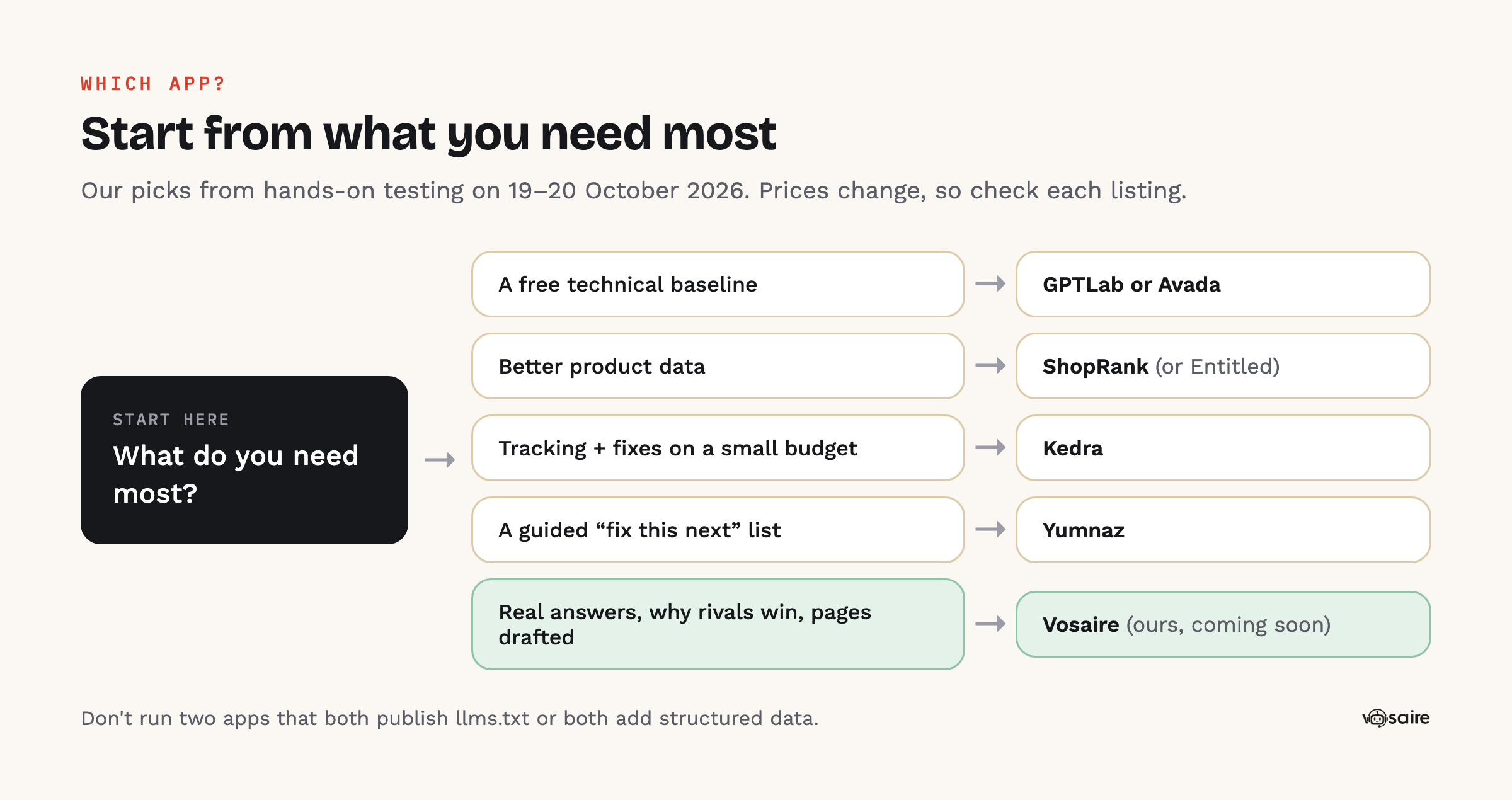
| Want a free technical baseline (llms.txt, structured data, crawler check) | GPTLab or Avada |
| Mostly need better product data | ShopRank (or Entitled for titles/meta only) |
| Want tracking + fixes on a small budget | Kedra |
| Want a guided "fix this next" experience | Yumnaz |
| Want to read the real answers, know why competitors win, and get answer pages drafted | Vosaire AI Visibility, once it launches |
You can combine types. A free technical app alongside one answer tracker is a sensible setup. Just don't run two apps that both publish llms.txt or both inject structured data, or they may clash.
What no app can do for you
Every app here helps with what's on your own store. None of them can make other sites mention you, and for competitive questions, those mentions often decide who gets named. Reviews, roundups, community discussion and creator content still take real work. Our guide on how to get your store recommended by ChatGPT covers that part step by step.
FAQ
Do I need an AI visibility app at all?
No. You can check ChatGPT by hand, fix product data yourself and write answer pages yourself. Apps save time on repeated checks across several assistants and on drafting fixes.
Are llms.txt apps enough?
Probably not on their own. An llms.txt file is a small, harmless extra, but there's no evidence that the major assistants rank stores by it, and Google says no special AI files are needed for its AI features.
Can these apps guarantee ChatGPT will recommend me?
No, and be wary of any that suggest they can. AI answers vary between runs and no app controls them.
How do I measure whether an app is working?
Track two things: how often assistants name you for your buyer questions, and how many visits and orders AI assistants send you. Our guide to tracking ChatGPT traffic and sales in Shopify shows how to do the second one with or without an app.
Where can I see a detailed comparison with Vosaire?
See our AI visibility app comparisons.