Blog / ChatGPT Ads / Pricing
October 25, 2026
ChatGPT Ads for Shopify: Cost, Results and What to Expect
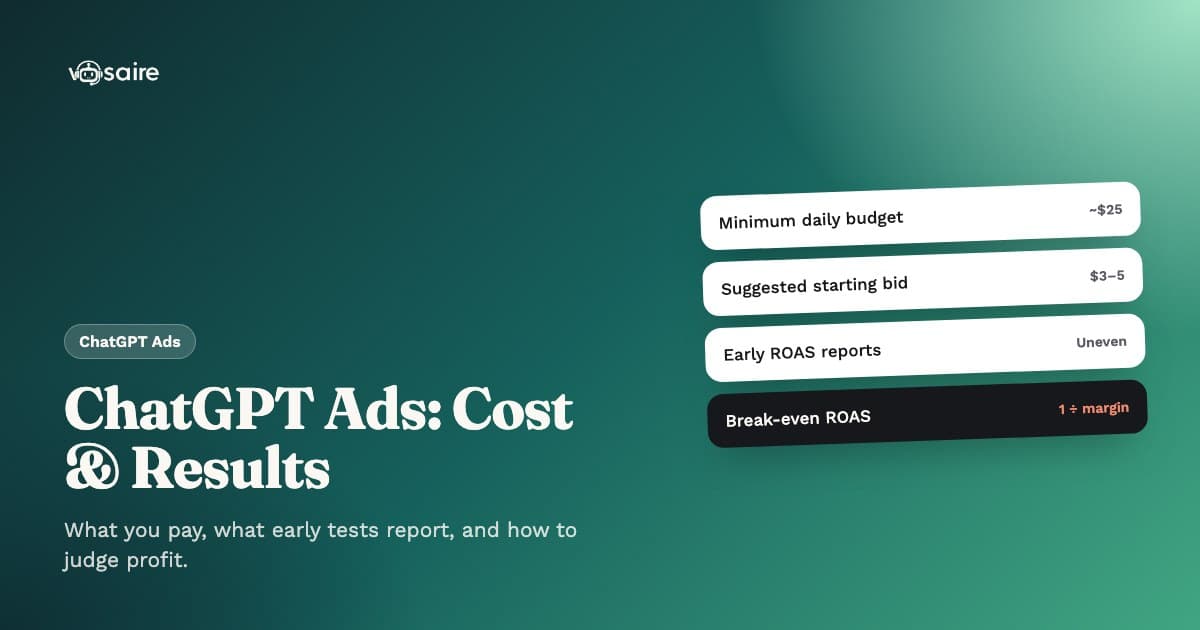
ChatGPT Ads have no fixed price: you bid in an auction and pay per click or per thousand views, with a minimum daily budget of about $25 in US dollars and a suggested starting bid of $3 to $5 per click. What you get back is much harder to pin down. The platform is months old, public results come from a few dozen agencies and advertisers, and they range from clearly profitable to clearly not, sometimes within the same account in the same week.
This guide explains how billing works, what early tests report (labelled by source), why results swing so much, how to judge profit rather than ROAS, and a two-week test plan you can run on a Shopify store. If you haven't connected your store yet, start with how to set up ChatGPT Ads on Shopify.
How billing works
You set a daily budget and a bid, and ChatGPT runs an auction each time an ad can show. As summarised from OpenAI's help center by Sprites:
- Click campaigns are billed per click (CPC).
- View campaigns are billed per 1,000 impressions (CPM).
- Conversion campaigns optimise for purchases but are still billed per click or per impression (oCPC or oCPM), never per conversion. You pay for traffic whether or not it buys.
- The auction is second-price and relevance-weighted: a more relevant ad can win without the highest bid, and you usually pay less than your maximum.
- Bid strategies: "Maximize results" (the default for eligible new ad groups, with no cost guarantee) or a manual max bid, which is a hard ceiling.
- Minimum daily budget: USD 25 (also CAD, AUD and NZD 25; EUR and GBP 15). There's no published account-level minimum spend; the large pilot-era minimums ended in May 2026.
- Suggested starting bid: OpenAI recommends a maximum of $3 to $5 per click to start.
- Billing: charged to your card after spend, starting at a low threshold that rises over time. A small temporary authorization hold may appear when you add a card.
One detail that trips people up: Ads Manager pre-fills a high max CPM bid on view campaigns. That's a ceiling, not the price you'll pay, but check it before launching.
What early tests report
Treat everything in this section as third-party, early and small-sample. These are agency write-ups and vendor case studies from 2026, not audited benchmarks, and the auction has changed a lot since the first tests (impression prices fell sharply in the spring, and click bidding only arrived in April).
| Metric | What's been reported | Source |
|---|---|---|
| Cost per click | Median about $4.41 across 15 dollar-billed campaigns; range $0.76 to $14.80 | ppcone.cz |
| Cost per click | $1.72 on one scaled e-commerce account | Opascope |
| Click-through rate | 0.6% to 0.9% in several US reports; median 1.25% across 24 international campaigns (range 0.35% to 7.9%) | Sprites, ppcone.cz |
| For comparison | Google Search CTR about 6.6% (WordStream, 2025–26) | Sprites |
| Conversion rate vs. Google | In four same-advertiser comparisons, ChatGPT converted at 0.2%–0.9% vs. 3.7%–6.6% on Google | ppcone.cz |
| ROAS | Opascope: about $60K spend → $89K revenue in 15 days (1.49x blended), with daily ROAS from 0.2x to 2.9x | Opascope |
| ROAS | Newegg: 3x over 28 days (OpenAI's own case study) | OpenAI |
| ROAS | Common Thread Collective: 3.3x to 6.8x on $9,620, depending on the attribution model | ppcone.cz |
What to take from this:
- Clicks are cheaper than Google's in many reports, but fewer people click and fewer buy. A cheap click isn't a cheap sale.
- Big-brand case studies don't transfer. Newegg is a large, well-known retailer with a deep catalog, and the case study is published by OpenAI. Your store's results will be your own.
- Platform-reported conversions can be generous. One advertiser in ppcone's roundup saw 36 conversions in the platform against 2 real enquiries. Always check against Shopify orders.
Why results swing so much
Opascope's own account went from 0.2x to 2.9x ROAS on different days. Several things drive that:
- Small numbers. At $25 to $100 a day and a few dollars a click, you get a handful of clicks daily. One order more or less changes the day's ROAS completely.
- Conversational intent varies. The same product can show next to "what's the best X?" (ready to buy) and "how does X work?" (just curious). You can't choose the question as precisely as a Google keyword.
- The auction is new and moving. More advertisers arrive every month, and early tests credited part of their returns to thin competition that won't last.
- Attribution is young. Reporting windows, delayed conversions (often a day or two to show) and pixel gaps all shift what each day looks like.
- Creative changes you didn't make. See "creative enhancements" below.
The practical answer: judge a test on a full week or two, never on one day.
Judge profit, not just ROAS
ROAS (revenue ÷ ad spend) ignores what the products cost you. A 2x ROAS can lose money. The number to know is your break-even ROAS:
Break-even ROAS = 1 ÷ margin
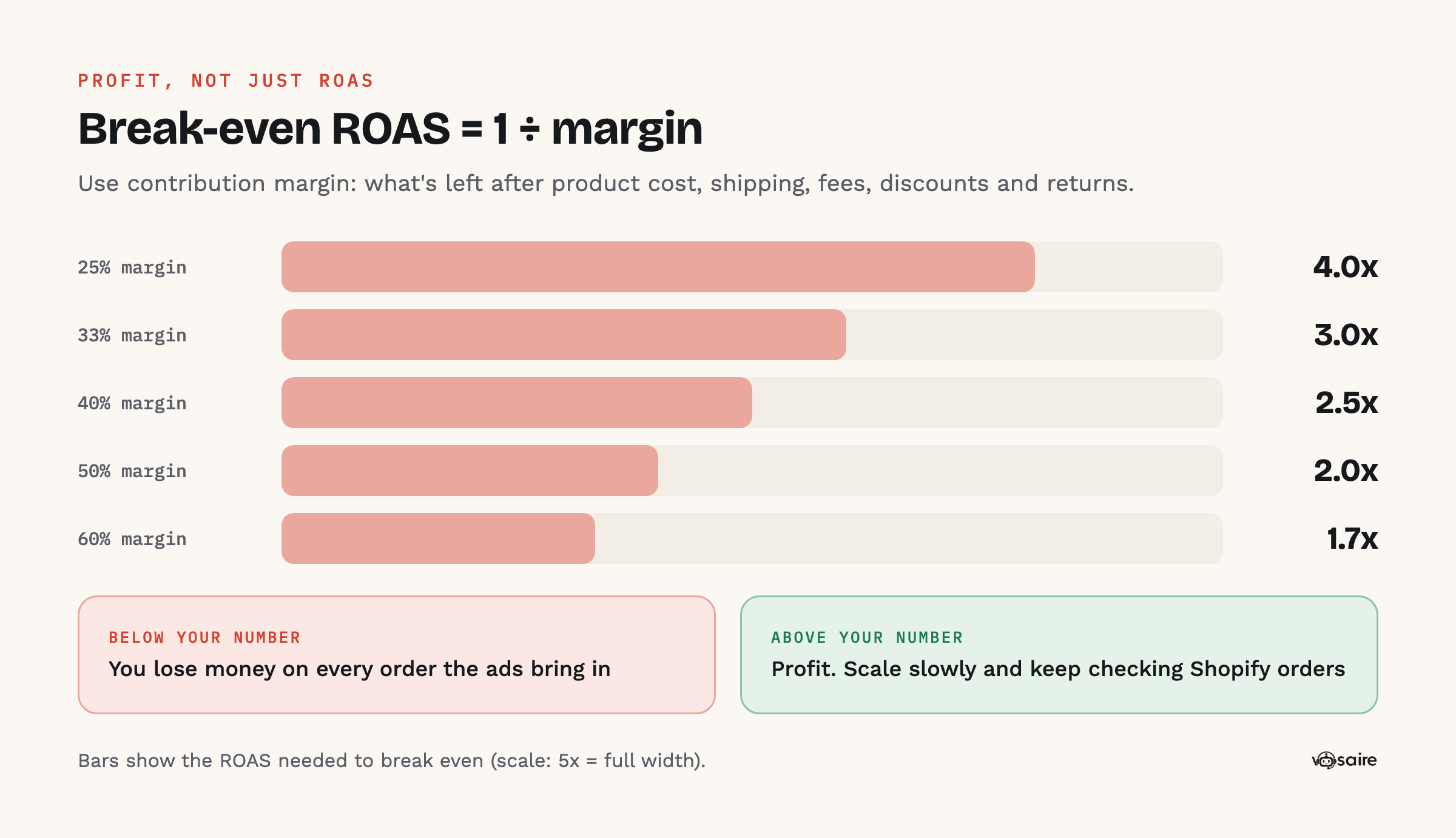
Use your contribution margin: the share of each sale left after product cost, shipping, payment fees, discounts and expected returns. For example:
- At a 40% margin, break-even ROAS is 1 ÷ 0.40 = 2.5x. Opascope's 1.49x blended result would lose money for this store.
- At a 25% margin, you need 4x just to stand still.
- At a 60% margin, about 1.7x breaks even.
Do the cost-per-order arithmetic before you launch, too. As an illustration: at a $3 click and a 1% conversion rate, each order costs $300 in ads. At 0.5%, it's $600. Unless your average order brings in more profit than that, or the customer reliably buys again, the test can't win. Shopify's profit reports can help here, as long as your product costs are filled in.
A sensible two-week test plan
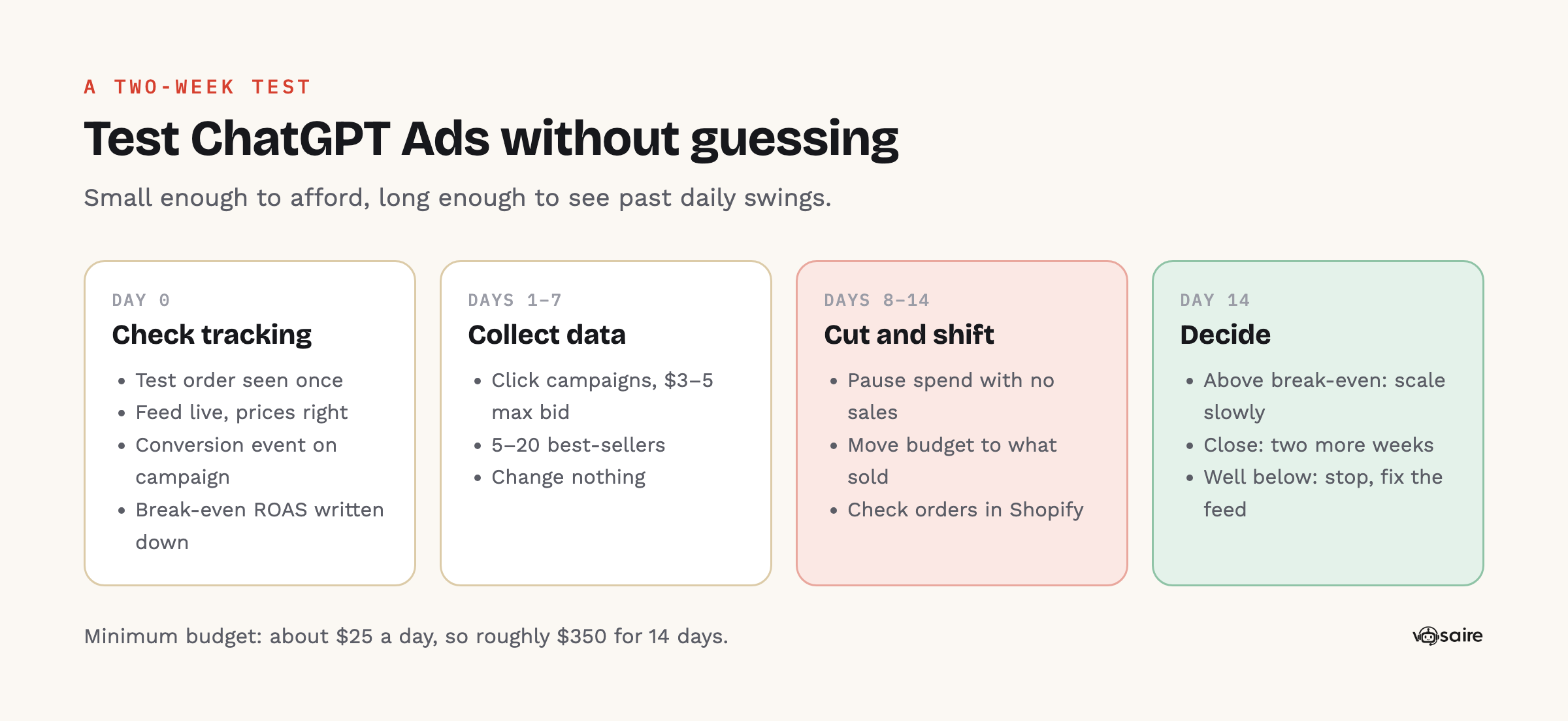
This won't prove the channel works at scale (Opascope suggests $5,000 to $10,000 for a baseline you can trust). It will tell you whether tracking works, whether anything sells, and whether a bigger test is worth it.
Before launch (day 0)
- Pixel, Conversions API and product feed connected, and a test order seen once in Ads Manager.
- A purchase conversion event selected on the campaign.
- Your break-even ROAS written down.
- A budget you can afford to lose: the minimum is about $350 for 14 days at $25 a day.
Week 1: collect data
- Start with click (CPC) campaigns and a manual max bid in the $3–5 range OpenAI suggests.
- Advertise 5 to 20 best-sellers with good margins, strong reviews and clear titles, not the whole catalog.
- Write ads that answer a question ("Waterproof hiking boots, wide fit, free returns"), not slogans.
- Don't change anything for 7 days. Daily swings are noise at this size.
Week 2: cut and shift
- Pause products with real spend (say, several times your target cost per order) and no sales.
- Move that budget to the products that sold.
- Check orders in Shopify, not just Ads Manager. Use ChatGPT traffic and sales tracking to see which orders came from ChatGPT.
Day 14: decide
- Compare profit from those Shopify orders against ad spend. Above break-even? Scale slowly, and consider conversion bidding now that the pixel has purchase data. Close? Run another two weeks with the winners. Well below? Stop, fix the feed and product pages, and revisit in a few months.
Which stores should wait
ChatGPT Ads aren't for every store yet. Consider waiting if:
- Your margins are thin. With a 25% margin you need 4x ROAS, well above most published results.
- Your average order is low. A few dollars a click and a sub-1% conversion rate makes a $20 order very hard to profit from.
- You can't spare a test budget. If losing $350–700 would hurt, put that money into channels you already know.
- Your tracking isn't reliable. Without a working pixel and Shopify-side checks, you won't know whether it worked.
- Your product category is restricted. Regulated categories face extra rules; check OpenAI's ad policies first.
- Your product data is weak. Fix titles, variants and images first. It helps both paid ads and organic ChatGPT recommendations.
Product feed quality matters more than you think
For product ads, your feed is your ad. ChatGPT matches a conversation to products using what the feed says, so:
- Titles should say what it is and who it's for: "Men's Waterproof Hiking Boot, Wide Fit", not "The Ridge".
- Use real variants with their own price and stock, not "ask us about sizes" in the description.
- Keep stock and price current. Advertising sold-out items wastes clicks. Refresh the feed at least daily; OpenAI's help center says feed items expire after two weeks without an update.
- Use clean images on a plain background, matching the variant.
- Exclude low-margin, out-of-stock and clearance items you don't want to pay to promote.
Creative enhancements: check your settings
OpenAI has announced creative enhancements for self-serve campaigns, switched on by default from the end of October 2026 (its email said 30 October; its help page said 29 October). With it on, the system can rewrite headlines and descriptions, resize images, change destination URLs and translate ad text, and run those versions without approving each one (PPC Land).
It may help or hurt; nobody has public data yet. What matters for a test is knowing whether it's on. Check Settings in Ads Manager for the "Creative enhancement" toggle. You can opt out for the whole account or per campaign, and a campaign setting overrides the account default. If you sell anything where wording matters (sizing, claims, compliance), review it before your next campaign runs.
FAQ
How much do ChatGPT Ads cost per month?
At the minimum daily budget of about $25, roughly $750 a month for one always-on campaign. There's no fixed monthly fee; you set the budget.
What's a good cost per click on ChatGPT Ads?
There's no reliable benchmark yet. Third-party reports range from under $1 to over $14, with a median around $4 in one roundup. OpenAI suggests starting with a $3–5 max bid. What matters is cost per order versus your profit per order.
What ROAS should I expect?
Published results range from loss-making to over 3x, and one account swung from 0.2x to 2.9x day to day. Work out your break-even ROAS (1 ÷ margin) and judge against that, over at least two weeks.
Do I pay per conversion?
No. Even conversion-optimised campaigns are billed per click or per impression. Conversion bidding changes who sees the ad, not how you're charged.
Are ChatGPT Ads better than Google Shopping?
Not on today's evidence for most stores. Click-through and conversion rates reported so far are well below Google's. The case for testing is reaching shoppers in a new, less crowded place, not beating Google on efficiency.
Should I turn off creative enhancements?
If you need control over exact wording, yes, at least until you've seen what it produces. Otherwise you could test one campaign with it on and one with it off, but at small budgets the difference may not be measurable.
Making the test easier to run
The hard part of ChatGPT Ads isn't launching a campaign. It's keeping the feed healthy, knowing which products actually make a profit after costs, and acting on that every day without overreacting to noise.
That's the job Vosaire: ChatGPT AI Ads Agent is built for: a Shopify app that shows real profit per product and per ad after ad spend and product cost, leaves out products that can't make money from an ad, and lets an AI agent cut losers and back winners within the limits you set, with full manual control alongside. It starts free, and paid plans start at $39 a month (your ad spend is paid to OpenAI separately). See how it works or compare plans.