Blog / Guides
September 14, 2026
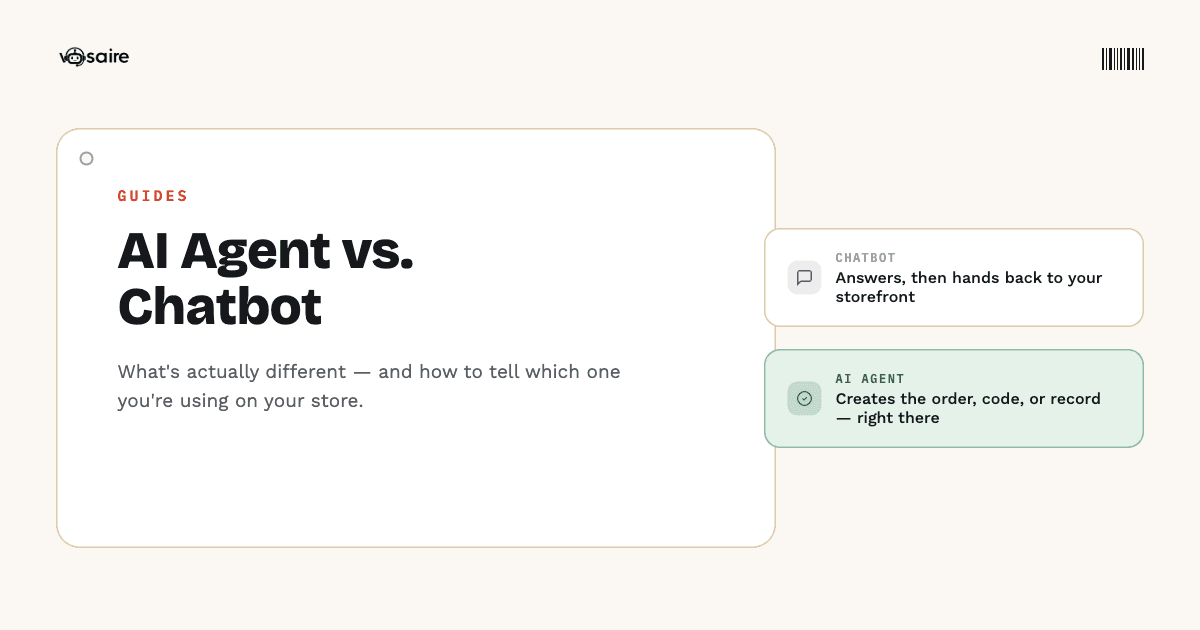
What Is a Shopify AI Agent? (And How Is It Different From a Chatbot?)
Open the Shopify App Store and search "chatbot," and half the results call themselves an "AI agent" instead — often for what is, underneath, the same product. The terms get used interchangeably enough that most merchants reasonably assume they're marketing synonyms.
They aren't — and it's not just app vendors drawing this line. Shopify's own guide on the topic makes the same distinction: chatbots are "reactive" and wait for a prompt; agents are "proactive" and can "initiate multistep tasks with minimal user inputs." The difference isn't how smart the AI sounds — it's what it's actually allowed to do.
Why this distinction is showing up everywhere right now
This isn't just semantics catching up to marketing. The category is genuinely shifting:
- The global AI-agents-in-ecommerce market was valued at $3.6 billion in 2024, and is projected to reach $282.6 billion by 2034 — roughly 78x growth in a decade.
- McKinsey projects the US retail market alone could see up to $1 trillion in orchestrated revenue from agentic commerce by 2030.
- Shopify's own 2025 merchant survey found 75% of established businesses already use AI tools — but fewer than one-third apply it to customer service, automation, or data analysis. Most current AI usage is still content generation, not action-taking.
(Stats via Shopify's AI agents overview.)
That last stat is the interesting one: most stores using "AI" today are still firmly in chatbot territory, whether their app calls itself an agent or not. Knowing the real difference is how you tell which side of that gap your own store is on.
What a chatbot does
A chatbot answers questions from whatever it was trained on — your FAQ page, your docs, your product descriptions:
- "What's your return window?" → answered from your policy page
- "Does this come in blue?" → answered from the product description
- "Where's my order?" → describes how to check, or points to a tracking page
That's genuinely useful, and it's why chatbots became the default first step for Shopify support widgets. But the moment the conversation needs something to actually happen — add this to my cart, email me when it's back in stock, give me a discount, look up my order — a chatbot hits its ceiling. It describes the product and points the shopper back to your storefront to do the rest themselves.
What makes something an agent
An agent takes the action itself, inside the conversation, instead of describing what the shopper could go do. That's the entire distinction — not vocabulary, a capability boundary. Concretely, for a Shopify AI agent that means:
- Building a real cart and checkout link — not a product-page link, an actual Shopify draft order created live during the conversation, with the customer's email pre-filled if it's already known, so the purchase finishes in the same chat it started in.
- Issuing a real, single-use discount code — created against your store's own discount rules (type, amount, expiry, limits you set), not a generic promo the bot happens to know about.
- Checking real, live inventory — and capturing a back-in-stock notification request the moment something's sold out, instead of just saying "sorry, that's unavailable" and losing the visitor.
- Looking up an actual order — and, critically, verifying identity first for anything sensitive (order details, cancellations, account changes), rather than handing out information to whoever happens to be typing.
- Recording marketing consent directly into Shopify the moment a customer actually agrees to it — a real opt-in event, not an assumption.
Every one of those is a write, not a read: something changes in your store's actual data — an order, a discount code, a customer record — because the conversation happened. A chatbot can talk about all of the same topics. It just can't close the loop.
Chatbot vs. agent, side by side
| Situation | Chatbot | AI agent |
|---|---|---|
| Shopper wants to buy | Describes the product, links back to your storefront | Adds to cart, hands over a real, working checkout link |
| Shopper hesitates on price | Repeats a generic promo, if it has one | Issues a real, single-use Shopify discount code |
| Item is sold out | Says it's unavailable | Captures a back-in-stock request on the spot |
| "Where's my order?" | Explains how to check | Looks up the real order — after verifying identity |
| Customer agrees to updates | No record kept anywhere | Writes real opt-in consent into Shopify |
Why the distinction is more than semantics
Every extra step a shopper has to take after the chat is a chance for them to not take it:
- "Here's the product, click through to add it to your cart" survives some of the time.
- A checkout link created and handed over inside the same message survives a lot more of the time, because there's nothing left for the shopper to figure out.
- The same logic applies to support: "here's our return policy" resolves the question; "I've started your cancellation request for order #4213" resolves the ticket — no follow-up email needed, nothing for your team to manually re-enter later.
None of this requires the AI to be smarter in the "understands language better" sense. It requires the app to actually be wired into your store — real Shopify API access to carts, discounts, inventory, and customer records — rather than sitting in front of your storefront as a read-only layer that eventually says "go check the website."
What this looks like across channels
The other half of "agent" versus "chatbot" is where the conversation happens at all:
- A chatbot is usually one widget, tied to one page.
- An agent that's genuinely doing your store's sales and support work shows up wherever a customer already is — the storefront widget, WhatsApp, Telegram, a support inbox over Gmail — with the same ability to look things up and take action in every one of them, not just the version embedded on your site.
The honest test
If you're evaluating a Shopify app and the listing says "AI agent," ask one question: can it create a checkout link, issue a discount code, or capture a back-in-stock request, right inside the chat — or does it just describe those things and hand the shopper back to your storefront?
The answer tells you, more reliably than the name on the App Store listing, which one you're actually looking at.
Vosaire is built as the agent version of this on purpose — see everything the Sales Agent and Support Agent actually do, compare it against what you're using today, or try it on your own store free, no credit card required.